Where 'Away' Runs Out: Inside the Bunkers Holding America's Poisoned Soil
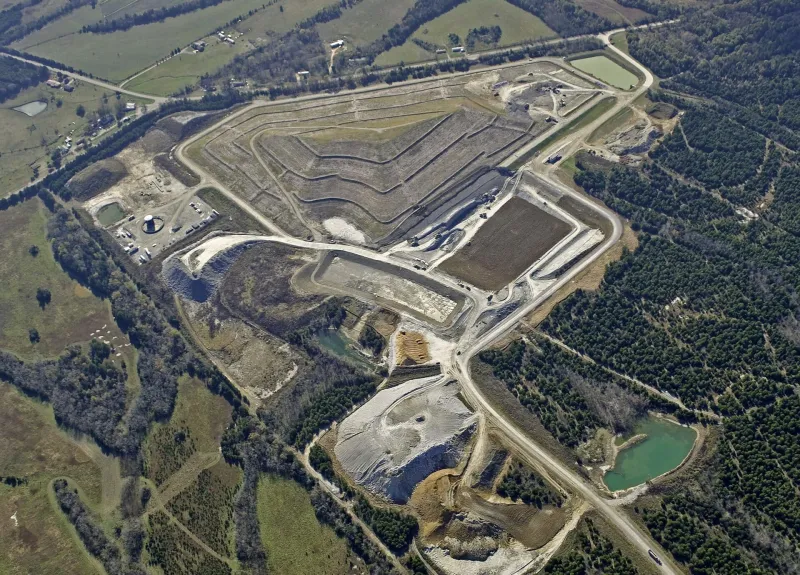
Photo: engineered landfill containment facility aerial view industrial, via www.hhnt.com
When a developer in Bridgeport unearths a plume of lead-laden fill, or a highway project in Michigan slices through decades of industrial residue, the contaminated soil has to go somewhere. Most residents assume it goes to a landfill. Fewer know that a significant share of it ends up in a stranger and more liminal place: a confined disposal facility, or CDF — an engineered enclosure where tainted earth is not so much disposed of as it is held, sometimes indefinitely, waiting for a disposal pathway or a policy solution that has yet to arrive.
These are, in a sense, the doomsday vaults of the remediation world. But while the Svalbard seed vault stores hope for a future harvest, American soil banks store a problem deferred.
The Architecture of Waiting
A modern confined disposal facility is not a hole in the ground. It is a carefully designed containment system: dikes or berms engineered to withstand flood events, composite liners of compacted clay and geomembrane, leachate collection systems that capture the contaminated water percolating through the material, and monitoring wells ringing the perimeter like sentries.
The Army Corps of Engineers operates some of the largest examples on the Great Lakes, where a century of dredging has removed sediment laced with PCBs, heavy metals, and polycyclic aromatic hydrocarbons. Facilities along the Chicago, Cuyahoga, and Saginaw rivers hold material dredged from federal navigation channels — earth that cannot simply be put back and cannot yet be safely reused.
The engineering is genuinely impressive. The philosophy behind it is more complicated. Containment is not remediation. The contaminants are still there, in many cases just as mobile as the day they were buried. What has changed is the geometry: they are now mobile inside a box.
The People Who Watch the Box
Maintaining these facilities is a career of patience. Engineers conduct annual inspections of dike integrity, test groundwater monitoring wells quarterly, and manage surface vegetation whose roots must be deep enough to prevent erosion but shallow enough not to breach the cap.
Just as important — and far less visible — are the watchdogs. Community groups near large CDFs, particularly in environmental justice communities that have historically shouldered a disproportionate share of the region's industrial burdens, have learned to read monitoring reports the way other residents read school board minutes. In Calumet Harbor and along the Indiana Harbor Canal, local advocates have pushed for decades to ensure that containment does not quietly become permanence without accountability.
Their central concern is straightforward: a facility built with a fifty-year design life is often treated as if it has a fifty-year maintenance commitment. Leases expire. Institutional memory retires. Funding streams shift. A containment cell that outlives its caretakers is a slow-motion problem.
Capacity and the Coming Reckoning
That problem is arriving on a schedule. Several of the nation's major confined disposal facilities are approaching their designed capacity, a fact that is forcing uncomfortable conversations in statehouses and county commissions from the Great Lakes to the Gulf Coast.
The options on the table are familiar and unpalatable. Expand existing facilities onto adjacent land — often land near the same communities that have hosted the burden for generations. Build new facilities, in an era when no one wants to be the town that volunteered. Or invest, at last, in treatment technologies that can actually destroy or immobilize contaminants rather than merely enclosing them — technologies that remain expensive, energy-intensive, and unevenly proven at scale.
Some states are experimenting with beneficial reuse: treating dredged material so it can serve as topsoil substrate, construction fill, or even landscaping material in capped parks. It is a promising direction, and one this publication has followed closely. But reuse markets cannot yet absorb the volumes arriving at the dock, and every ton diverted still leaves many more behind.
A Question of Honesty
The deeper issue exposed by the capacity crunch is linguistic. Americans have been taught to think of contamination as something that gets removed — hauled away to a place called away. The soil bunkers make the fiction visible. Away is a dike in someone's floodplain. Away is a lease that comes up for renewal. Away is a monitoring well that needs to be read by someone whose agency still exists.
None of this is an argument against containment, which remains an essential tool in the remediation toolkit. It is an argument for candor. If we are going to store our poisoned earth in engineered waiting rooms for decades, we should fund them like the multigenerational commitments they are, site them with the consent of the communities that will live beside them, and treat the development of true destruction technologies as the urgent national project it has never quite become.
The dirt is not going anywhere. Neither, increasingly, is the question of what we owe it.