The Wind's Ledger: Tracking Legacy Contaminants Through America's Former Mill Towns
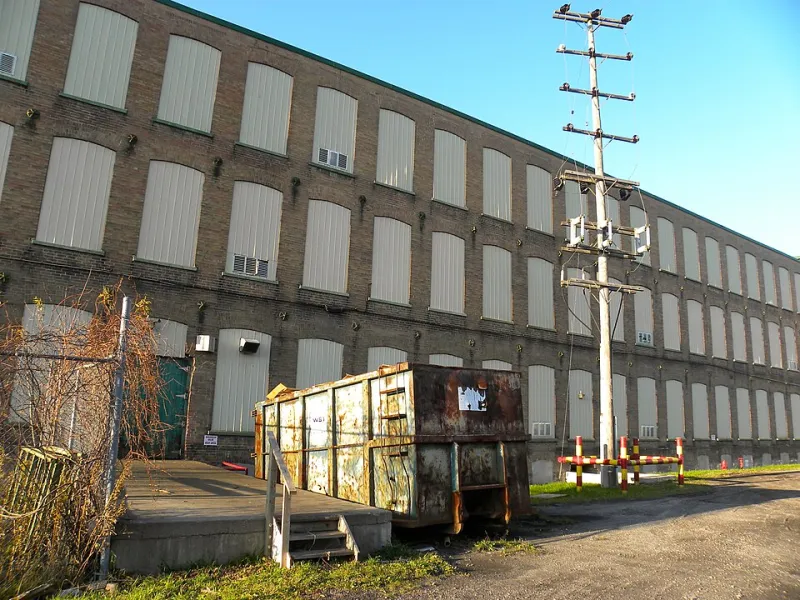
Photo: JasonParis from Toronto, Canada, CC BY 2.0, via Wikimedia Commons
On a gray morning in Torrington, Connecticut, an environmental consultant kneels beside a storm drain and scoops a spoonful of gray silt into a sample jar. Three blocks away, a brass mill operated for more than a century before closing in the 1980s. The building is gone. The company that ran it no longer exists as a legal entity. The metal in the sediment, however, is very much present.
Scenes like this unfold across the Rust Belt and New England every year. The factories closed, the jobs left, and the towns moved on — but the contamination did not. It sits in soils, embeds in floodplain sediments, and waits for rain, wind, and bulldozers to set it in motion again.
What Happens After the Smoke Clears
The legacy of a century of industry is not confined to a factory footprint. Smelters and mills emitted metal-laden particulates from stacks for decades, and those particles settled across entire neighborhoods. Lead, arsenic, cadmium, and chromium now form diffuse halos of contamination that can stretch for miles from a former stack.
This scattered contamination behaves differently from a concentrated spill. It has no clear boundary, no single pipe to cap, no plume to pump and treat. Instead, it moves episodically. A spring flood scours a riverbank and deposits metal-rich sediment in a park. A construction crew excavates a lot and stockpiles tainted soil where children later play. A dry summer wind lifts dust from an unvegetated slag pile and carries it into a schoolyard.
Researchers sometimes describe this as contamination's second life. The first life was the smokestack era. The second begins when the material becomes mobile again.
Following the Sediment
Hydrologists studying former mill towns often start at the water. Rivers that once powered the mills — the Naugatuck, the Housatonic, the Cuyahoga — also served as their waste channels. For generations, process water laden with metal filings, oils, and chemical residues flowed directly into these waterways.
What went in did not disappear. It settled into the sediment behind dams, in oxbows, and along slow-moving bends. As those dams age and communities debate their removal, an uncomfortable question arises: what happens when the impounded sediment is released?
In several New England towns, dam removal projects have been delayed or redesigned specifically because of contaminated sediment behind the structures. Engineers must weigh the ecological benefits of a free-flowing river against the risk of mobilizing decades of industrial residue downstream, sometimes toward communities that already bear an outsized share of the burden.
The Liability Gap
Here is where the story turns from scientific to civic. The federal Superfund program and state cleanup statutes were designed to hold polluters accountable — but many of the companies that built the mills incorporated in the 1800s and dissolved generations ago. Their assets are gone. Their records are scattered in local historical societies, if they survive at all.
The result is a category of contamination that regulators privately acknowledge falls through the gaps. Superfund sites receive federal attention when the threat is severe enough. State brownfield programs address parcels slated for redevelopment. But the diffuse contamination between those sites — the metals in the floodplain soil, the dust in the attics of century-old homes — often has no dedicated funding stream and no responsible party to pursue.
Who pays, then? Increasingly, the answer is the municipality, the homeowner, or nobody. A family that tests its yard and finds elevated lead faces an impossible choice between remediation costs that can exceed the home's value and living with the exposure. Towns that want to build a riverwalk or affordable housing on former mill land must budget for soil management that was never anticipated.
Residents as Researchers
In a number of affected communities, the response has come from below. Grassroots soil-testing initiatives, often run in partnership with university labs, have mapped contamination patterns block by block. Volunteers collect samples from yards, playgrounds, and garden beds, and the resulting maps frequently reveal patterns the official record never captured — hotspots tracing the path of a long-demolished rail spur, or elevated readings downwind of a stack that vanished fifty years ago.
These citizen datasets do more than document a problem. They change the conversation. When contamination is invisible and diffuse, it is easy for officials to treat it as a abstraction. A map showing elevated lead in the soil of a daycare's play area is not an abstraction.
Community groups have also pushed for practical, immediate measures: raised garden beds with clean soil, mulching bare dirt, hand-washing stations at schools, and soil screening at playground renovations. These are not substitutes for comprehensive cleanup, but they narrow the exposure gap while the larger questions are litigated and legislated.
Rethinking Responsibility
The deeper issue is structural. American environmental law was largely built to identify a polluter and make that polluter pay. It handles point sources and discrete sites reasonably well. It handles dispersed, historical, orphaned contamination poorly — and that category is vast, encompassing hundreds of mill and smelter towns across the Northeast and Midwest.
Some states have begun experimenting with dedicated funds for orphan sites, financed by fees on hazardous waste generation or real estate transfers. Federal infrastructure funding has, in recent years, directed new money toward legacy pollution cleanup, though advocates argue the sums remain a fraction of the need. Others propose that the polluter-pays framework be supplemented by a shared-responsibility model, in which the public cost of cleaning land that generated public wealth for a century is acknowledged rather than denied.
None of these approaches is simple, and each raises legitimate questions about fairness and fiscal capacity. But the alternative — leaving the contamination to move on its own schedule — has a cost too, measured in blood lead levels and lost land value and the slow erosion of trust between towns and their institutions.
The Ground Under the Story
There is a temptation, in talking about deindustrialization, to speak in the past tense. The mills closed. The era ended. But the material record of that era is not past; it is particulate, and it obeys the physics of wind and water rather than the calendars of policymakers.
The towns living with this inheritance are not asking for nostalgia or ruin tourism. They are asking for something more mundane and more difficult: an honest accounting of what is in the soil, a plan for keeping it out of lungs and gardens and rivers, and a funding mechanism that does not require the polluter to exist in order for the cleanup to happen.
The dust will keep moving. The question is whether our institutions will move with it.